
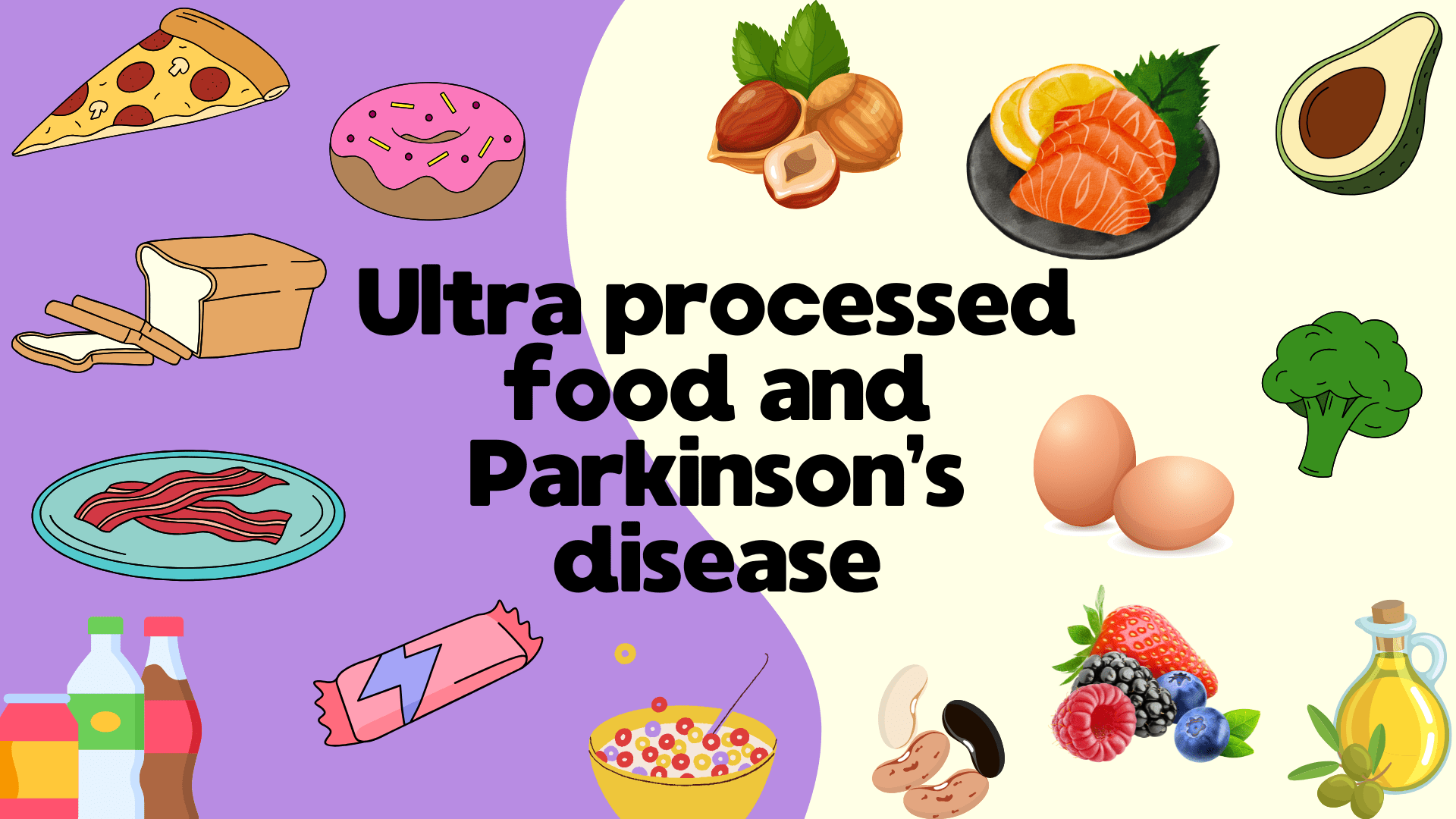
Even quick snacks like instant soup or energy bars might seem harmless, but new science suggests there’s more to consider. Ultra-processed foods (UPFs)—from snacks and sodas to frozen meals—are everywhere in our diets, and recent research indicates they could be linked to more than just gaining weight. Aside from being associated with obesity, cancer, and heart issues, UPFs may increase our chances of developing early symptoms of Parkinson’s disease.
–> We fund independent information like this through donations – support our patient-led research
What exactly are ultra-processed foods (UPFs)?
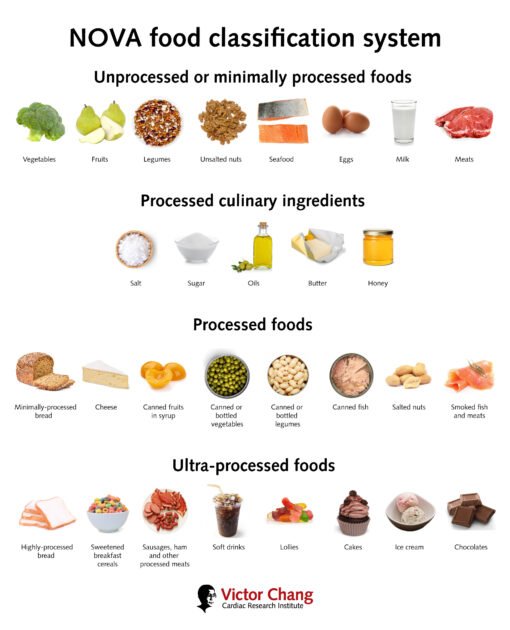
“Ultra-processed food” is a term created by Brazilian epidemiologist Carlos A. Monteiro. It describes industrialized, “ready-to-eat” items that typically contain more than five ingredients 1. Think pre-packaged meals, sauces, spreads, soft drinks, and treats like chocolate or chips flavored with sour cream and onion. UPFs are highly appealing: they combine lots of sugar, saturated fat, and salt in a way that makes them so tasty and addictive, it can be hard to stop eating.
–> Parkinson’s disease: the basics explained simply
Parkinson’s disease and UPFs: Do it these foods cause Parkinson’s disease?
So far, no research has proven that UPFs directly cause Parkinson’s disease. However, a study published in 2025 in the medical journal Neurology found that people who eat more UPFs are more likely to show early signs of Parkinson’s than those who eat less.
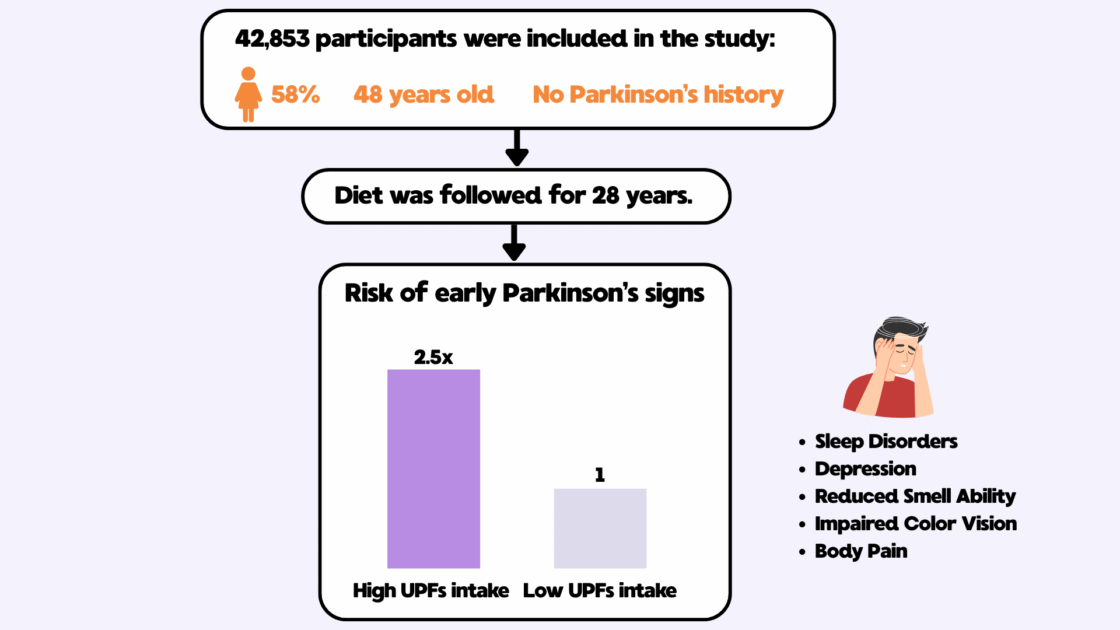
For this study, Dr. Xiang Gao from Fudan University in China analyzed data from two large long-term US studies started between 1976 and 1986. Over the years, participants completed health and lifestyle questionnaires and underwent medical exams. Dr. Gao and his team looked at 42,853 participants who had no history of Parkinson’s. The average age was 48, and 58% were women. They tracked these individuals for up to 26 years, and reviewed their answers on sleep disturbances, constipation, excessive daytime sleepiness, depression, and body pain—possible early indicators of Parkinson’s disease.
The researchers examined the participants’ food diaries, which detailed what they ate and how often, to determine their daily UPFs intake. A typical UPFs serving was equivalent to a can of soda, an ounce of chips, a slice of packaged cake, a hot dog, or a tablespoon of ketchup.
The findings highlight a clear link between UPFs consumption and Parkinson’s disease: people who ate a lot of UPFs (11 or more servings of UPFs daily) were more than twice as likely to show early signs of Parkinson’s than those who ate very little.
Wondering how ultra-processed foods affect the brain?
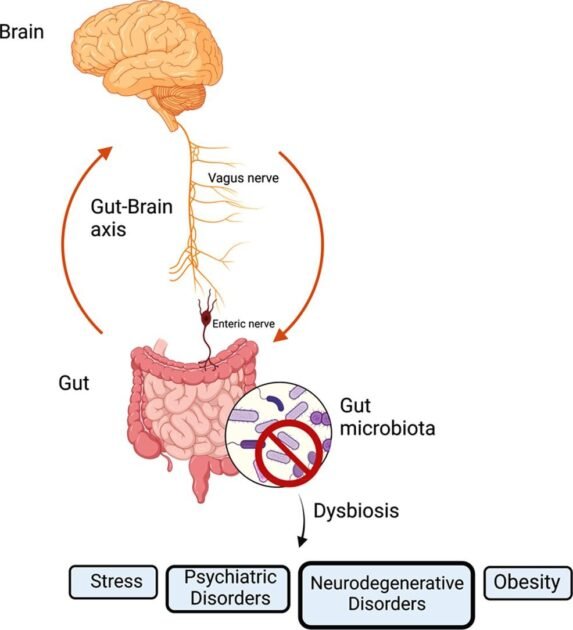
UPFs impact the brain through our gut microbiota, which is made up of billions of tiny organisms like bacteria, viruses, and fungi living in our digestive system. The gut and brain are connected by the vagus nerve, a communication highway. Just as the brain sends signals to tell our gut we’re hungry, the gut also influences brain function by producing vital hormones and neurotransmitters that play roles in behavior, learning, and memory 2. UPFs’ lack of essential nutrients (vitamins, minerals, and healthy fats like omega-3) compromises the production of these vital molecules.
–> More on the possible role of the gut in Parkinson’s disease
Your gut microbiota works like a garden—when UPFs take over, weeds spread and crowd out the healthy plants. Unhealthy habits can lead to the overgrowth of harmful microorganisms that cause inflammation, increasing the risk of disease. Research involving people with bowel inflammatory conditions found that intestinal inflammation can cause alpha-synuclein to clump together in the gut 3. According to the increasingly popular “gut-to-brain” theory, Parkinson’s disease may start with aggregated alpha-synuclein spreading from the gut to the brain 4. Certain bacteria in an altered gut microbiota are also linked to how severe Parkinson’s can become 5.
Thinking about avoiding ultra-processed foods?
There’s no need to toss out every packaged food with five or more ingredients. UPFs remain a good (and sometimes the only) option for low-income families. Some preservatives help keep food fresh and prevent mold or bacteria from growing.
If you’d like to be more mindful at the grocery store, here are some simple tips:
- Use the rule of thumb: if a product has ingredients you don’t recognize or can’t find in your own kitchen—like emulsifiers, stabilizers, or flavor enhancers—it’s probably an UPF.
- Steer clear of ingredients with complicated names, such as maltodextrin, soy protein isolate, or hydrogenated oils.
- Look for quick and healthy alternatives. Preparing a lettuce wrap filled with canned fish and avocado is just as easy as microwaving instant soup.
- Opt for cooking at home more often. A Mediterranean diet, rich in whole grains, vegetables, fruits, legumes, and nuts, with less meat, can be especially beneficial for those with Parkinson’s 6. Planning meals and batch cooking make sticking to healthy habits simpler.
- Buy organic and untreated food, or grow your own in your garden.
Final thoughts about Parkinson’s disease and UPFs:
Every small step counts when it comes to your health. Choosing foods that are minimally processed is always a wise choice. And don’t forget to check food labels: fewer ingredients usually mean a healthier option.
–> If you value independent, patient-led information, please help by making a donation— every single contribution helps us.
More about us
–> Back to the Parkinson’s Blog
References
- Monteiro CA, Cannon G, Levy R, et al. NOVA. The star shines bright. World Nutrition. 2016;7, 28–38. https://repositorio.usp.br/item/002869059
- Needham BD, Kaddurah-Daouk R, Mazmanian SK. Gut microbial molecules in behavioural and neurodegenerative conditions. Nat Rev Neurosci. 2020;21(12):717-731. doi:10.1038/s41583-020-00381-0
- Espinosa-Oliva AM, Ruiz R, Soto MS, et al. Inflammatory bowel disease induces pathological α-synuclein aggregation in the human gut and brain. Neuropathol Appl Neurobiol. 2024;50(1):e12962. doi:10.1111/nan.12962
- Oliver PJ, Civitelli L, Hu MT. The gut-brain axis in early Parkinson’s disease: from prodrome to prevention. J Neurol. 2025;272(6):413. Published 2025 May 21. doi:10.1007/s00415-025-13138-5
- Lin CH, Chen CC, Chiang HL, et al. Altered gut microbiota and inflammatory cytokine responses in patients with Parkinson’s disease. J Neuroinflammation. 2019;16(1):129. Published 2019 Jun 27. doi:10.1186/s12974-019-1528-y
- Maraki MI, Yannakoulia M, Xiromerisiou G, et al. Mediterranean diet is associated with a lower probability of prodromal Parkinson’s disease and risk for Parkinson’s disease/dementia with Lewy bodies: A longitudinal study. Eur J Neurol. 2023;30(4):934-942. doi:10.1111/ene.15698