
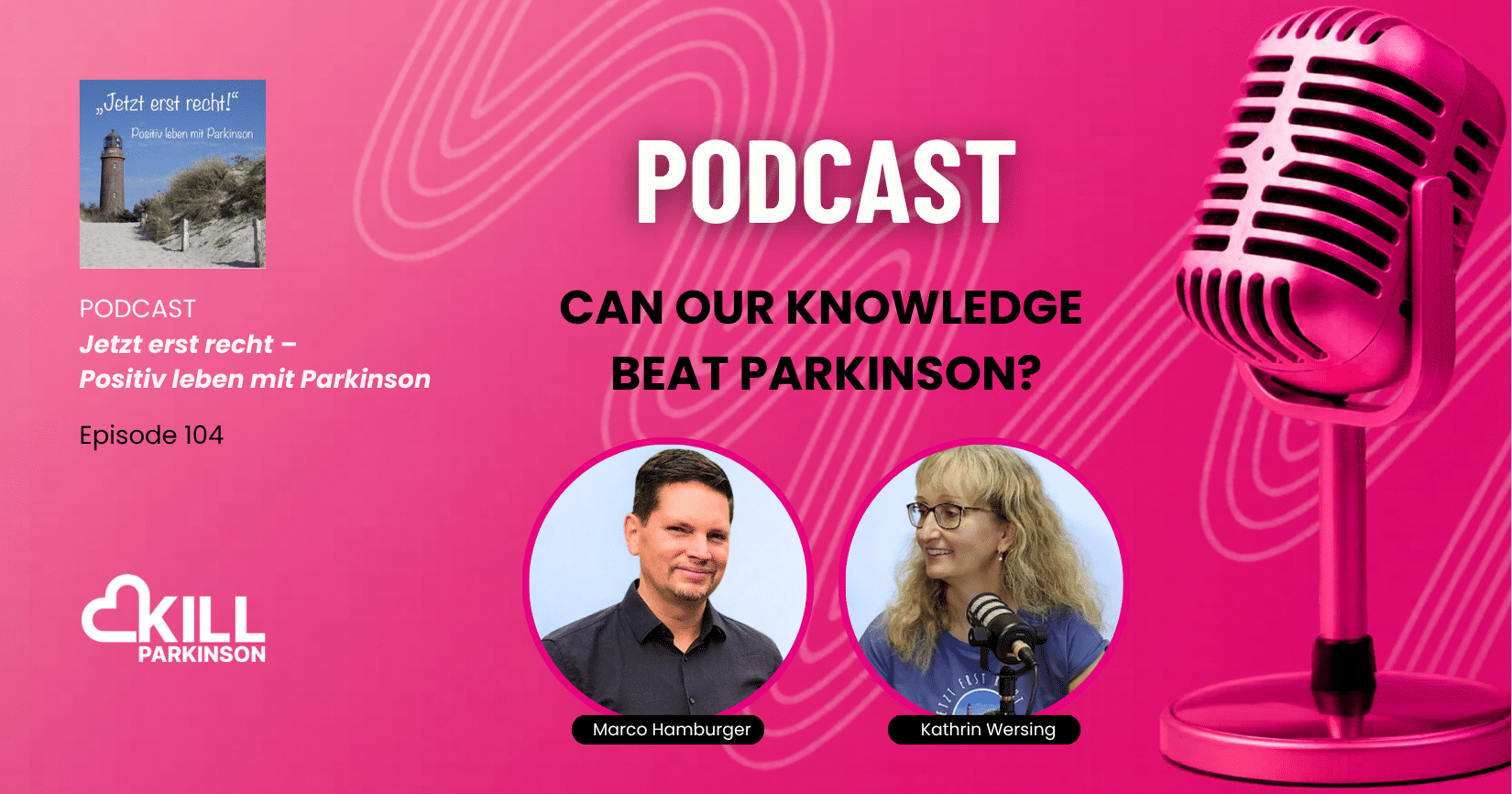
A transcript from the podcast “Jetzt erst recht – positiv leben mit Parkinson“, Episode 104: “Kill Parkinson: Can Our Knowledge Defeat Parkinson’s?” Guest: Marco Hamburger, founder of Kill Parkinson. Links to the podcasts below.
Intro and Introduction
Kathrin:
Hello and welcome to episode 104 of my podcast “etzt erst recht – positiv leben mit Parkinson‘s”. My name is Kathrin Wersing and for over 5 years I’ve been speaking here with people who have been diagnosed with Parkinson’s and with their loved ones.
Together we try to find out what keeps us going in life despite and alongside the disease, what gives us strength, and what helpful impulses and strategies we want to pass on to others.
Today I have Marco Hamburger as my guest – someone I pursued quite persistently with my podcast invitation, because I’ve been following his project called “Kill Parkinson” with great interest for some time. Today he finally tells us more about his idea: building a worldwide registry in which he wants to collect data from people with Parkinson’s, in order to support fundamental research and prevention.
It’s a wonderful conversation with an impressive man. I hope you enjoy listening. Good morning, Marco. Welcome to my podcast today.
Marco:
Good morning from Berlin.
Kathrin:
Well, it finally worked out between us. I’ve wanted to have you on the podcast for so long, I reached out several times and there were always various reasons why the timing wasn’t right – but now it works, and I’m especially happy to be able to speak with you today. And as always, my first question is: What have you already laughed about today?
Marco:
I actually laughed a lot yesterday evening – I watched 2 hours of Minions with my five-year-old son, who is a total Minions fan, right before going to sleep.
Kathrin:
Oh, cool.
Marco:
My wife was away, so it was just the two of us, and it was so funny – we really love the Minions and can just laugh our heads off watching them. And there were so many great moments. And since I was out with him again this morning – picking up his bike from nursery and then getting some bread rolls and fresh bread – we had plenty of time to chat about it again and keep laughing.
Those were the first moments of the day when I woke up this morning, and it was great.
Kathrin:
Yes, very cool. You really can have a good laugh at the Minions – they get up to so much nonsense.
Marco:
Exactly, but it’s definitely one of those things – you either hate them or you love them. And thankfully, my son and I are firmly in the love camp and have a great time with them.
Kathrin:
Yes, great – my boys love them too. Marco, for everyone who doesn’t know you yet: How would you describe yourself in 3 sentences?
Marco:
Well, generally that’s an exercise I really don’t enjoy. Even though I’ve been working for 30 years, I genuinely dislike talking about myself – I don’t even know why, it just developed that way at some point.
I might describe myself the way my wife would: as someone who is always searching, always exploring, always wanting to optimise and improve things, always wanting to try new travel destinations – the person who drove her completely crazy on a road trip through the USA a few years ago because I wanted to peek around every corner, climb every mountain and then head into every park.
That’s probably how she’d describe me. She might also say I’m a family person, that as a Rhinelander I generally have a good sense of humour, but that I can also be quite persistent when something matters to me and I’m determined to see it through.
I’m probably a bit of a workaholic too – yes, that’s developed over the last 30 years: there’s always something to do. Then Uncle Parkinson joined the party, inevitably. I’m basically always busy with something, so I’m a very occupied person – but of course I also make lots of time for the family now, and I make sure to do that.
The Diagnosis – A Shock Just Before Christmas
Kathrin:
Yes, lovely. Thank you – that’s already a great glimpse into your life. And you already mentioned “Kill Parkinson” – that’s the project that first put you on my radar. We’ll dive into that a bit more in a moment, and I’m really looking forward to it. But I’d first like to go back to your life with Parkinson’s. Could you perhaps take us back to that time – how it all started, when and how you first noticed the early signs of your Parkinson’s diagnosis?
Marco:
Well, I got married in 2015, and around that time a few things started: I had a kind of stabbing pain in my thigh, shoulder pain. Then at some point I started noticing that whenever I used the cross-trainer at the gym, my left foot would cramp up.
And then I went to the orthopaedist for several years, even saw a neurologist for a check-up, and nobody could really explain it. I was also in physiotherapy, logically, even twice a week at some point, and it just didn’t get better. I did a lot of sport, was basically fit as a fiddle – but things just didn’t regulate themselves or improve.
That’s how the first few years went in terms of symptoms. And then eventually the diagnosis came – one I hadn’t really seen coming at all.
Kathrin:
So you hadn’t suspected what it might be – it hit you completely out of the blue.
Marco:
No, even though I work professionally in the healthcare market, Parkinson’s wasn’t on my radar. Sure, I’d had neurology appointments and knew it might be something neurological – but when you’re not really familiar with what serious neurological conditions are out there, you don’t necessarily think of the worst when you’re trying to figure out what you might have.
But then it started pointing more in that direction because I started feeling nauseous when typing on a keyboard. So it was becoming clear: OK, it’s probably something neurological. But Parkinson’s was never something I’d looked into – other than knowing about Muhammad Ali and Michael J. Fox – I have to admit that, because there was no history of Parkinson’s in my family.
And then it was December 2017 – I remember it very clearly – just a few hours before our company Christmas party with around 150 people, I was once again at the neurologist, went through the usual neurological tests, walked down the corridor, did the hand movements – and then he was absolutely delighted to be able to tell me that I probably had Parkinson’s, delivering the news with total enthusiasm.
I, of course, did not find it nearly as amusing as he apparently did.
Kathrin:
Yes, I can understand that.
Marco:
And then it was confirmed as Parkinson’s – we double-checked with a DaTscan of course – but then it was clear on all counts: Parkinson’s, yes.
Kathrin:
So that was just before Christmas, and just before a huge company Christmas party – and you received the diagnosis. Did you still go to the party?
Marco:
Of course, that’s just the kind of person I am – you don’t let something like that derail your plans. And naturally people could tell something was up and asked, but I said: OK, I don’t want to talk about it right now – and that was accepted.
But then a few months after the diagnosis I spoke to everyone at work and went public with it, because I eventually knew what kind of impact it could have on my job. I’m in consulting, in an advisory firm, and I advise clients. And it was clear that I shouldn’t keep it hidden for long, especially since I was still in management at the time.
Being Open About the Diagnosis – At Work and in the Family?
Kathrin:
Yes, but brave nonetheless. I know many people, especially in senior positions, who say: no, I won’t say anything yet, because I’m afraid of losing my job or being treated differently. But I’ve also had the experience that it’s actually the only way to find some peace and continue living your life, when you speak openly about it. But it certainly wasn’t easy, was it.
Marco:
Exactly. Of course you still try to hide your symptoms for as long as possible, and naturally to manage things with medication so that as little as possible is noticeable – that’s logical. But you put it exactly right: it gives you peace of mind.
Because then everyone knows. All my clients know. I’m very open about it publicly – on LinkedIn and all the other platforms I’m active on. My employer and my managers knew within a few months. That’s already 8 years ago now.
I still work today, my performance is naturally not at the level it once was, but I still look after my clients well, I believe – whether they’re equally happy with me. And it’s of course reassuring to know that they can also accept it when my voice gives out, when I’m on screen in a web meeting – which you do a lot these days – and start getting a little restless et cetera.
It’s much better that they know what’s going on, rather than thinking: OK, Marco drinks or has some other kind of problem. They know: it’s something neurological. And as I said, they are mostly pharmaceutical companies we advise, so they understand the medical side of things. I’ve been completely open about it and it has never in any way turned out to be a disadvantage.
Kathrin:
That’s wonderful, that sounds really great. I know many other people who have had different experiences, or who have a great fear of being open about it. And it’s so valuable that you can speak so openly about it and encounter understanding.
I think we most often do encounter understanding. There will always be situations where you come across someone who reacts oddly, but the vast majority can understand it. And as you rightly say: when people know what’s going on, they see things differently. Otherwise so much arises from not talking, from not saying anything – and then people have a thousand things running through their heads: Oh, what on earth could be wrong with him.
Marco:
Yes, unfortunately that’s how it is.
Kathrin:
Yes, I think that’s really admirable.
Marco:
Yes, but I also understand that there are naturally other jobs where it’s not so easy. I’ve benefited from being in the healthcare sector, from working in a very – how shall I put it – open-minded company where a lot of ideas are discussed, from having founders who were very open to many things you could talk about – I also had clients who worked in neurology, or who were very close to the Parkinson’s topic. We also had various Parkinson’s projects where we advised pharmaceutical companies and developed strategies for them.
So I was in a fortunate position there. I can also imagine that in other jobs, where perhaps the boss has a different approach, or in large corporations that are very performance-oriented, people might think: OK, they can see what the prognosis is. They know that at some point you won’t be able to work anymore and that your performance will decline – that’s just how it is.
Nobody knows whether that will take five years, ten years or fifteen years, or maybe even just two to twelve months – anything can happen. Of course that’s a risk, also an economic risk for a company, and I understand everyone who reacts in that way.
But I would always give the advice: speak openly about it in all directions. With my family, for example – I told my immediate family, my mother and her friends, relatively quickly of course. But for example my aunts and uncles, who are already quite elderly, only found out in recent months, the last year or two – because I kept it to myself, because I didn’t want to burden them with something that wouldn’t benefit them at this point. They’re all quite old, some of them have already passed away, sadly. But at work it was clear to me from the start to go public with it fairly quickly.
Kathrin:
Yes, OK, interesting – so you handled it differently with family than professionally. But that’s also sometimes the case – when you don’t see people that often, they always see you through a slightly different lens, don’t they. I can also understand saying you don’t want to burden others, wanting to protect them a little.
Marco:
Yes, especially since I live in NRW and only see them once or twice a year – at some summer gathering or a milestone birthday. You don’t really want to say at those moments: OK, by the way, one more little thing – I have Parkinson’s. It’s just not a topic you want to bring up in that setting.
Kathrin:
Yes. You already mentioned that you came clean with your closest family straight away. That’s often not easy at all – I know from my own experience how hard it was to tell my parents, or my children. How was that for you, and how did your family cope with it?
Marco:
Well, my wife found out on the same day, of course. She could see straight away that something was wrong and that it wasn’t good news. And at first we were completely in shock as a couple, because we both had a bit of Stephen Hawking in our minds – however that connection came about, not Michael J. Fox. We knew he had Parkinson’s too, but we somehow assumed the severe form was what Stephen Hawking had – even though we now all know he had a completely different condition.
So we could already see our hopes going up in smoke and pictured Marco in a wheelchair within a few years. Because of that I was truly in shock for weeks and months, until we gradually got more information. Up until that point we hadn’t told the wider family.
And then the next time we saw my mother, her friends, and my brother, we told them. And everyone deals with it differently.
My mother has been strongly affected by it, to be honest. Every time we see each other now, I get a very intense hug, and it always feels somehow like a final farewell – even though we see each other relatively often. For her it’s clearly a heavy burden to know that her son is left with this illness.
My brother and his family took it relatively calmly. They’re also Christians, like my wife and I, and have a certain optimism in life that things will work out well somehow.
But my wife and I really did struggle during those first years. We went through a kind of honeymoon phase, as many do, and then realised: OK, the disease isn’t progressing as fast as we’d feared. We enjoyed our life a little more, and then decided to have a child despite the Parkinson’s diagnosis – which was absolutely the right decision. Best decision of my life, I can genuinely recommend it to anyone, because the disease then developed much more slowly than we’d feared in the worst case.
Kathrin:
Yes, exactly.
Marco:
But it was still of course a years-long situation – first the shock. Then we also had years of difficulty talking about it, even in our relationship as a couple. We focused on moving forward professionally, on taking care of our son. But we couldn’t really talk about the illness, because we didn’t have a real solution.
If you have a problem where you know: OK, there are various approaches to solving it – then that’s fine. But if you have an illness where you know you’ll probably die significantly earlier, and also age in ways that will prevent you from working properly, from providing for your family – then that is of course a massive burden initially.
And now we can talk about it, but it’s also not really our favourite topic, understandably. We simply know that for certain things, when it comes to planning, we have to think a bit differently than other families might. But it’s not as if we eagerly talk about the illness. The symptoms and everything that comes with them already have such a high impact on your own life, on family life and on the people around you, that we don’t really put the topic on the agenda very often.
Kathrin:
Yes, thank you for that honest insight. I think many people feel the same way – that it’s often hardest with the people closest to us, the ones who matter most, isn’t it. I can say that from my own experience too.
I also made the mistake for a long time, I think, of trying to protect my husband and my children – saying: look on the bright side, it’ll be fine, I can manage. But the less you include others, the more you leave them on the outside too.
It’s not always easy. But I keep finding that when you have children, they bring a lightness to things. You can talk about it briefly and then there’s a joke or something funny and then – yes, exactly, we don’t have to take all of this so seriously. We live in the present, not in tomorrow or the day after. The kids often help me with that. Mine are teenagers now – so there’s already plenty of action, at your place too from what I’ve heard, right.
Marco:
Yes, absolutely. We have lots of kids around too – in the family and among friends. Life goes on, but of course – as I said – if you were to sit down as a family and plan everything out radically and objectively, mapping out all the worst-case scenarios, that’s hard.
We haven’t really managed to do that completely objectively in recent years, because we also have a little more hope that things might still develop well, that something might yet be found. Because the fact is, 8–9 years after my diagnosis, I’m still doing relatively well.
Of course I have my off periods and I now take dopamine every 2 hours during the day – which is quite a high frequency – and now naturally also dealing with all the side effects around food and so on. But still, I’m doing well, I can do sport, I can travel, I can do my job and I’m still available for the important things in life.
I’ve received very different prognoses at times. And so – things are still going well for me – but making a fully realistic plan with various worst-case scenarios for the coming years is still genuinely difficult.
Kathrin:
Yes, and that’s the strange thing – when you think about it carefully, life is actually not plannable for any of us. None of us know what tomorrow brings, anything can happen. And yet we have this feeling that we need to be able to plan. That was very hard for me at the beginning too – now I can let go of it quite well and just think: something will work out, let’s wait and see what comes and then deal with it.
Marco:
Yes, as they say – tomorrow has enough worries of its own, so it’s enough to focus on today.
Kathrin:
Yes.
Marco:
And you can’t really plan tomorrow anyway. Of course you could also step in front of a lorry tomorrow and then life is over. Anything can happen, and then you’ll have spent 10 or 15 years worrying about how things would play out long-term. But we’re all a little bit German, aren’t we.
Kathrin:
Exactly. In Germany you always have to worry, always expect the worst.
Marco:
Yes, and you have to do a bit of planning, exactly. No, but I think we all have a certain basic optimism in us – maybe we Germans just let it out too rarely. We can certainly laugh about life too – I think we’ve proven that often enough.
But of course you still try to plan for retirement in the long term and think about other things, and don’t want to leave your son with some enormous drama at the end involving debts or other issues. But yes, as I said, you have to bring some optimism, and I think that’s what has helped keep me doing relatively well today.
Kathrin:
Yes.
Marco:
And things seem to be going pretty well for you too, don’t they? I’ve been listening to your podcast for years, and you give the impression of coping very well with Parkinson’s and having excellent treatment.
Kathrin:
Yes, very much so. I also spoke recently with my doctor at the Parkinson’s outpatient clinic at the university hospital, and she said: these are simply the young-onset people – those who develop the condition early tend to have a significantly slower progression, she told me. They just run a different course than people who develop it much later, where things move faster. And I thought: well, at least that – if we start so early, it’s only fair that it also moves more slowly for us. That’s what I thought.
Marco:
That’s true, that’s true.
Kathrin:
And I also heard in a study recently that people who develop Parkinson’s young have a significantly lower risk of dementia. That I’ve remembered. The other things I forget, but anything positive – I always hold onto that.
Marco:
Excellent, I’m writing that down immediately – can I put you on my wall?
Kill Parkinson’s Registry – The Idea Behind the Project
Kathrin:
Yes, exactly like that. But the fact that you still have so much hope is shown by your wonderful project. I first became aware of you a few years ago when I heard the words “Kill Parkinson”. Could you – before I say anything about it when I really have no idea – tell us what Kill Parkinson is about and exactly what it is?
Marco:
Yes, so first of all: sorry for the very aggressive name, but it somehow came to me when I was thinking about the project. What is it? A mission, a vision, a great hope ultimately – that from all the knowledge that exists within our Parkinson’s community – that’s over 10 million people who are apparently affected worldwide, plus all their loved ones – that we somehow hold a wealth of knowledge about our biographies, about our lives, about our therapies, and that from all this knowledge you can identify patterns.
Because we have a very clear problem right now: fundamental Parkinson’s research simply isn’t making sufficient progress. Sure, we now know that people who have worked in agriculture or on a vineyard, for example, often develop Parkinson’s because they come into heavy contact with pesticides. But for many, many other people, it’s relatively unclear why they developed Parkinson’s.
I personally have no single reason I could point to for why I got it. I’ve never been exposed to environmental toxins professionally or where I grew up. So that’s a little bit of the background with Parkinson’s – that there must be patterns somewhere that we can uncover.
And today we have AI, we have excellent analysis software, we have excellent research worldwide. Even if it’s partly pharma-funded and naturally tends to focus on symptom management, because that’s where the money is – surely something can be extracted from all this data. That was the founding principle.
And I was in Beelitz for a few weeks at the Parkinson’s clinic near Berlin – that was August 2023 – getting my Parkinson’s medication adjusted. And there, for the first time, after years of having pushed the disease to the side and not wanting to meet with any patient associations or self-help groups – I hadn’t felt I needed that kind of support – I was of course sitting next to a Parkinson’s patient every single day, doing archery with them and playing table tennis et cetera.
And it became clear: OK, there’s actually a problem in the research here too. This disease has existed for over 200 years and somehow we haven’t really made sufficient progress. When I look at how quickly HIV and other conditions became treatable and the underlying problems were identified, there seems to be a fundamental research problem with Parkinson’s – perhaps because the disease isn’t yet properly understood.
I used that opportunity, spoke with many people, including various neurologists, and then started researching in a place where I actually had the time for it. Three weeks without family, without work – it was simply a time when I had a great deal of time for research, more than I rarely have in my life.
And I started doing some research and thought: OK, what does research need? Research needs data above all. The more data you have, the more information you have, the more you can analyse, identify patterns, develop strategies.
And then I asked the first neurologists – right there in Beelitz – OK, what would it mean if you had significantly more patient data? Well, that could obviously be a great foundation for finding out much more, including for fundamental research.
Then I asked: OK, what if you could get a few hundred thousand of the 10 million – or back then I was working with 8 million, I think, three years ago – what if you could get that many people to share all their information? How they grew up, what they ate, what jobs they had, what their blood count looks like, what a DaTscan shows et cetera?
If you brought all that data together digitally in a database and made it available to researchers – could that help achieve breakthroughs with Parkinson’s? Nobody said no. Everyone said: yes, I can well imagine that’s the case.
Then I started talking with a woman about whether we couldn’t do something – a charity in that direction – and start collecting this data worldwide. That was the trigger back then.
Kathrin:
Yes, fascinating. I didn’t have such a groundbreaking research idea, but that’s how it felt with my podcast back then too. I had this idea in my head and it wouldn’t leave me. I kept thinking: well, who are you to do this, and who would want to share their story with you – all those kinds of limiting beliefs you carry around. But the idea wouldn’t let me go.
And it was the same for you. I believe ideas that won’t leave us alone need to go out into the world. And that’s why I think your project is also so important – because it wouldn’t let you go either, and it’s clearly swept others along with it too, as I’ve seen.
Your homepage – which is really wonderful, we’ll link to it, I can highly recommend it, it’s beautifully done and very informative – maybe briefly, before we dive in: who is involved, what is your vision, where do you want to go? A quick summary.
The Parkinson’s Registry: Collecting Knowledge, Finding Patterns, Improving Lives
Marco:
So the vision is that we have a very simple system – accessible online, whether by phone, tablet or computer – where you can compile all this information that I just described.
All the biographical information: Where did you live, how did you grow up, how did you eat, what sport did you do, what social relationships did you have, were there separations, were there traumas or accidents in your life, how do you brush your teeth, have you had any other illnesses et cetera. Basically everything that could have some kind of impact on health.
And that’s a few thousand topics. We have 15 major areas and 100 sub-categories, each with hundreds of questions. It’s a big task to fill in, because there are simply a lot of things that could influence health – but we want to make it relatively straightforward for people to enter these things digitally, completely anonymised and completely untraceable back to any individual – obviously, that’s an absolute requirement.
And we want this data ideally from people in Ethiopia just as much as from Australia, the USA and Germany, then compile it all and make it available to researchers, anonymised of course, and see what patterns emerge – that’s the plan.
And since entering all this information is quite a big undertaking, as I just described, we’re doing it with a lot of gamification. There are mascots that accompany you on your journey through the database. “Keeper” is the name of the main mascot – an abbreviation of Parkinson, so to speak.
And KiPa is a little dog, who along with his team guides you through the journey. And when you’re in the Nutrition section, for example, there’s a different mascot alongside you. And each time you complete one of the sections, that mascot gets unlocked and you can see it and interact with it.
So we’re trying to make it a bit gamification-like, because we think that has a lot to do with keeping people motivated. We’d also like to add statements once we finally go live – for example: Kathrin explains why she thinks the project is so wonderful and why she thinks it’s great that you take the time to enter your information.
That’s what we’re working on at the moment. The database itself is roughly in place – I’d say about 80% done. But the whole gamification element and making it look great – that’s what we need to accomplish in 2026.
Because, as always, it’s all taking much longer than planned. I’m coming from a world where you could set things up relatively quickly with significant pharmaceutical funding, to a world where we now have around 25 volunteers spread across the globe trying to get everything off the ground in our spare time and at weekends – and that’s of course a huge amount of work and organisational effort.
That’s why everything has taken much longer than hoped. When we founded Kill Parkinson at the end of 2023, I thought we’d be done in 2 years. Now it’s almost 3 years later and we’re not even live with the registry yet – but we have achieved many other wonderful things in the meantime. Everything just takes so much longer than you’d like.
Kathrin:
Yes, because it’s learning by doing – you haven’t typically built 5 registries in your life before, so you learn as you go. I can also see from our pre-conversation that all kinds of topics keep coming up for you. Exactly.
But I find it totally fascinating – you already mentioned your team, that you’ve been able to bring 25 people from around the world on board to volunteer for the project and contribute real time, energy and expertise. What kind of people do you need for a registry like this, who’s involved in terms of professional competence?
A Global Volunteer Team – From Los Angeles to Indonesia
Marco:
Well, you start out not knowing who you need. The most recent people we’ve brought on are character designers – a role I didn’t even know existed. Character designers take care of characters in gamification elements – so things like our mascots – and develop the story behind them that motivates people to engage. What should that look like?
Our most recent addition is Michelle, who started a few weeks ago and comes from Canada – she’s a character designer. Before her came Cansu, who works in the legal field and is currently helping us with all our legal documentation and developing an ethics committee concept and approval process. Before that came Adam – he’s a lecturer in design at a university in the UK, also a character designer, and he’s currently building the entire story world.
So many people have joined. I think we’ve had around 40 to 50 people on the team over the last 3 years. Not everyone has stayed, that’s understandable. But a good number of people have been with us for over 2 years now.
Three years ago when we started, I never would have thought you could achieve this with volunteers. Back then I thought –
Kathrin:
I wouldn’t have thought that either, honestly. I’m genuinely amazed: where did you find them, and genuinely well-qualified people at that – they don’t just call up and say “I want to join”, so how, how do you get them?
Marco:
Yes, it was crazy. I’ve run a few startups in Berlin and also mentored startups. And the usual model there is: you have 2 or 3 people building a startup in their spare time, then you raise big investment and then you can hire people.
So that’s what I thought: OK, you write the concept for Kill Parkinson together with your wife, and then you need to raise significant funding. And I was genuinely thinking in the multi-million range – what you’d need to build a team worldwide that you could pay, do global PR to get media coverage, and run the whole registry – as I knew it from the commercial world.
Then I realised: OK, this is very unlikely to work out in terms of raising that kind of money. And I thought: OK, what could a leaner path to that goal look like? I’m not sure how, but I somehow ended up on LinkedIn. And on LinkedIn you can always post a job listing for free, even as a volunteer organisation.
And so I started looking, I think, for a programmer to help me with the WordPress website – because I’d built it myself first, more badly than well. It was at least colourful, the branding stood out, but beyond that it didn’t have much going for it.
And then Christos from Greece joined us – he was an army officer who had started programming on the side – and said: OK, I think this project is really exciting, I’d love to do it.
And then I really discovered: through these LinkedIn listings where I was looking for volunteers, thousands of people have now applied over the last 2 years. Regardless of what role we were advertising – whether legal, programmer, or designer.
Then we eventually brought on Alena, who as Head of Staff keeps in touch with team members to check how they’re doing. Because when you have people spread out – we currently have people sitting everywhere from Los Angeles to Guatemala to Europe all the way to Indonesia, plus an Australian who lives in southern Spain but is originally from Australia and is there occasionally. So we essentially have every time zone covered.
And all these people need to be managed somehow. They never see each other – we’ve never had an in-person meeting. I know some people personally of course, but I know most people through video calls, which is already challenging when you hold a big group call every 2 months or so. Not everyone can always be there, simply because of all the time zones.
Kathrin:
Yes, someone always has midnight or something like that.
Marco:
Yes, exactly. And Alena makes sure the team members are happy, that they give feedback when things aren’t working for them, when they need a break because things are stressful at work or they’re under pressure from studying, or whatever the case may be.
And it’s already quite a significant organisational undertaking to manage all of this. I’d say roughly half our resources go towards simply organising ourselves, finding meeting times, and optimising how we work.
We now also have an onboarding process. Before, I used to do all of that on my own – telling people what Kill Parkinson is about, sending them some kind of work agreement et cetera – now we have all of that built into the process.
Then we brought on Anil, who handles all the technical setups. We use around 5–6–7 different software systems for communication, for data protection-compliant storage of information et cetera.
So you really do have everything in the team – like a small company. We don’t have a doorman yet and we don’t have a warehouse operative driving a forklift around, but otherwise we feel like we have almost everything covered.
And of course it’s also true that not everyone stays forever. Someone joins and maybe it turns out differently from what they expected – that happens too. Then we might have a neurologist in the UX/UI team who is, funnily enough, both a neurologist and a designer, who will be moving on to something else, because we actually need her in a dedicated capacity to review medical content. So it’s really fascinating how people develop within the team. You need everything, but I never would have anticipated at the start just how many different roles I’d need to fill. That all of these people work on a voluntary basis – that is truly remarkable. I’m grateful every single day for having so many wonderful volunteers worldwide who support us so brilliantly, and that everyone puts in hours at weekends and sometimes late at night without any pay to keep things moving forward – that’s extraordinary.
Kathrin:
But that also speaks to your project, your idea, your mission – it shows that there’s a real connection there, where people say: I genuinely want to be involved in something this important, to be part of it and maybe part of the solution.
Marco:
Yes, exactly. Where we could still really use more people is specifically people with Parkinson’s. We do have some team members who have family members with Parkinson’s. The team is still relatively young, you have to say that too – which of course also brings a lot of energy, to be honest. These people have the enthusiasm to get involved, including at weekends and in their free time.
But it would be really great to have a few more people join who bring some energy – but who also perhaps bring Parkinson’s with them – especially when it comes to the whole topic of therapies and side effects and all the challenges that unfortunately come with this condition, so that we can assess these things a little better.
Kathrin:
Yes. OK, let’s put that out there: anyone listening to this podcast who has the thought – wow, what a great project, I’d love to get involved, I have Parkinson’s, I’m personally affected or perhaps involved as a family member – please do get in touch with Marco. It certainly sounds like a very, very exciting project. I’ve already said I’d love to get involved myself, but unfortunately I have too many projects on the go. But I think the idea is brilliant.
Marco:
That’s completely fine – you have to focus.
When Does the Registry Launch?
Kathrin:
When will the registry actually launch?
Marco:
The plan was actually to launch at the beginning of the year, but I’ve now said: OK, let’s take one step back – especially since we also still need to bring a few more people onto the development team. Because once we go live, we’re live. Everything needs to work.
Well, not everything will work perfectly, but we need 99% to work. And we also need to be in a position to develop things quickly once we’re live – either when we identify things that aren’t working well, or when things are working and we want to build on them. Right now we don’t have the resources for rapid development, either on the design side or the developer side. So I’ve said: let’s wait until we’re truly ready, and then launch.
And I very much hope it will happen this year – that we’ll be in a position where I can say: OK, the system works, it’s properly built, cleanly set up. We also still need to finalise all the legal details, all the legal contracts – because the data people enter is highly sensitive, obviously.
We also still need ethics committee approval. We’ve now at least found an ethics committee that is willing to review us. Before this, 5 to 10 turned us down – we wrote to 5 to 10 ethics committees and they all said: we’re not responsible for this, you don’t have a study initiated by doctors or clinics or a pharmaceutical company, you’re simply collecting patient data worldwide in an online database. You don’t need an ethics committee for that.
But we said: OK, we still want to go through the approval process, because once we want to share the data with researchers, we’ll need it anyway. We’ve now finally found one that’s willing to review us. It does cost some money – money we currently don’t have in the account, to be honest.
So we’re currently working through all the applications and need a few donations in the account in order to carry this out. It only costs 600–700 euros, but that money isn’t there right now, because we’re essentially living hand to mouth since we work on a voluntary basis and don’t have any revenue streams as such.
So I very much hope that this year we can go live with something that’s cool, fun and testable, and that we can then continue to develop.
Kathrin:
Yes, wonderful. And just to put it out there again: donations to the project are very much welcome. And I’ve seen that you can already put yourself on the waiting list on the homepage, if you want to be kept informed. There’s a newsletter, I believe, right? And there’s social media too – you can follow them to stay up to date with the project and be there when it launches.
Marco:
Yes, exactly, all of that is possible.
Kathrin:
Who exactly can take part? Is it only people with Parkinson’s entering their data, or could family members also participate?
Marco:
Family members can also take part, absolutely. It just needs to be someone who has a lot of information or a close connection to the person affected – because from vaccination history to childhood illnesses et cetera, we want to collect as much information as possible.
Every piece of information is valuable. Of course not everyone needs to fill in 100% of the questions, but naturally the more we receive, the more meaningful it becomes. And it should be someone who isn’t just going from hearsay, but who is genuinely close to the affected person and can follow up when certain things are unclear.
Kathrin:
Yes. And how many datasets would you need for meaningful results?
Marco:
I’ve said we definitely need to reach six figures in terms of the number of patients. Behind each person there are hundreds of questions, possibly even over 1,000 in total. They don’t all need to be answered – you can pick and choose which areas to focus on.
You might say: OK, I’ll start with my childhood, or I want to share something about my physical activity over the years, or I want to talk about how I’m being treated today, what challenges I face, perhaps including medication side effects or symptoms of the disease. Everyone can select the areas where they feel they have something to contribute.
But clearly: if we’re starting from 10 or 12 million people affected worldwide who are currently living with Parkinson’s – we should be able to bring a few hundred thousand together globally. And as I said: I’ve never spoken with a single Parkinson’s patient who said they wouldn’t share their data and knowledge.
Sure, data protection matters, but the data protection enthusiasts are generally not the people who are chronically ill. When you’re chronically ill – and this is a disease that cannot be cured – you are very willing to share your information. Of course it needs to be anonymised, that’s completely clear. But I don’t know a single Parkinson’s patient who wouldn’t say: OK, I’m happy to share all my information if it can help us identify patterns and defeat the disease. Count me in.
What Concrete Benefits Does the Kill Parkinson’s Registry Offer for Those Affected?
Kathrin:
Exactly, that’s what it’s about – it has a concrete benefit. The benefit isn’t just for people who are newly diagnosed or who come after us with a Parkinson’s diagnosis, but it should also offer a concrete benefit for those of us already affected, right. What might that look like?
Marco:
Well, one example: I personally don’t know of any good overview of all the therapies that exist – including alternative therapies. One person does Tai Chi, another does yoga, the next takes high-dose Vitamin B1, another swears by Mucuna pruriens capsules. Another says they’re completely happy with Levodopa, it works great for them, or with dopamine agonists.
What I’d really love to have quickly – actually even for myself, funnily enough – is a global overview: who uses which therapies, what has helped for how long? How many people are currently having deep brain stimulation, for example? Especially in the USA that’s a huge topic, it’s been extremely hyped on all social media platforms for years. Sure, there’s a lot of money to be made from it, but I also know enough people for whom it didn’t work, who had to switch it off after years because it had only helped short-term.
That would be one benefit I’d see materialising quite quickly – within a few months of going live, you’d start pulling together the information that’s there: who took which therapies, what helped with which symptoms, for how long did it help, how long did it perhaps not help.
To have that quickly in a well-organised database, so that someone could enter: OK, I’m a Parkinson’s patient, I’m 43 years old, I’ve just been newly diagnosed. OK, what have other patients at your age done globally, what has helped them?
Of course we can’t give therapy recommendations, that’s obvious, but we can at least collect the experiences other patients have had over the years and present them clearly. Because back when I was diagnosed, I received nothing – my neurologist sent me home. I got no brochure, no website, nothing I could have used to inform myself.
Kathrin:
Yes, same for me.
Marco:
Probably the same for you. Probably 90% of people who get Parkinson’s – or perhaps another condition like MS or dementia – are sent home with nothing, no onboarding to their illness. There’s no real way to get informed, other than to start Googling, using AI et cetera – which is of course also the right approach. You can find a lot of information, and all the charities do many wonderful things. But a therapy overview like that – conventional medicine and alternative therapies compared side by side, observed over many years – I haven’t seen anything like that which could have helped me.
Kathrin:
Yes, yes, absolutely.
Marco:
And prevention is the other major topic. I want to do everything I possibly can to prevent my son, my wife or anyone in my family from getting Parkinson’s. And there are certain fundamental things you can pay attention to in order to reduce the likelihood of developing Parkinson’s – eating organically, avoiding pesticides, staying away from toxins et cetera.
These are things that are demonstrably helpful in reducing the probability of developing Parkinson’s or dementia or other conditions. And that information also needs to get out there.
Until I got Parkinson’s at 42, I’d never thought about it. Barely knew how to prevent it. And I genuinely spent many years in Berlin celebrating life et cetera. In hindsight I’d do all of that differently and wouldn’t recommend that lifestyle to my son either – even if it was a fun time.
You can have a fun life without drinking a lot, without spending many nights out in clubs – a lifestyle that doesn’t really lend itself to healthy living. I think there’s a lot of information that can be brought together to help people avoid many things in life. And those are hopefully two areas where we can relatively quickly deliver value, pull together the information, and improve the lives of people with Parkinson’s.
Big Dreams: Where Should Kill Parkinson Be in 5 Years?
Kathrin:
Yes, very cool. They always say you should dream big. I’m a firm believer in that, because I think many people often say: oh, with Parkinson’s I can’t do that anymore and I can’t do that anymore, and I’d better just forget my dreams. And I think that’s complete nonsense, because I believe we must and we’re allowed to keep dreaming big.
And if everything goes to plan with Kill Parkinson – dream big: where do you see your mission in 5 years?
Marco:
If everything goes to plan, Kill Parkinson won’t exist in 5 years. We won’t need a Parkinson’s charity anymore, because by then we’ll have found a way to control the disease through medication to the same extent as with HIV – so that you can live a full life alongside it. And ideally something that even provides a vaccine that prevents our loved ones, friends, family and others from getting Parkinson’s. That would be the ideal scenario. Of course everyone says after 200 years: that’s currently unrealistic, but you never know.
Kathrin:
Exactly, and I believe that too. Because right now in Parkinson’s research there is so much in the pipeline. The researchers are also saying – I was recently at the Parkinson’s congress in Leipzig, where it keeps being said: there are many very promising things out there. But you do need time and money and data for that. And Kill Parkinson is now one part, can be one part, that contributes – perhaps not just to a greater understanding, but also to a better overview and uncovering patterns that, without all these datasets and without AI, simply couldn’t be seen before.
Marco:
That would be wonderful.
How Can You Get Involved and Support the Project?
Kathrin:
Yes, so – we’re already doing well for time. So let me ask the final question. Marco, what would you like to pass on to the people listening?
Marco:
Well, ultimately everyone makes their own decisions about how they live their life. The Parkinson’s diagnosis did slow me down and shock me for a few years. But I would simply recommend to anyone who receives the diagnosis: approach it calmly, take comfort in knowing that it really does take years – in general, especially if you’re diagnosed young – before Parkinson’s has a strong grip on your life. You have to acknowledge that it can happen, but it doesn’t happen overnight.
I’d be really happy if we can bring together many people who simply believe in the idea that if we pool all the knowledge we carry in our heads – the therapies we’ve experienced, our biographies – if we compile that together, it can help drive research forward.
And anyone who can support us in any way is enormously helpful, because over the coming years we will also need some funding to ultimately realise the idea, bring it to the world, do PR – so that people in Ethiopia, Australia, South America, even Russia and elsewhere, where perhaps media reach is limited, that we can reach those people and they can contribute their information.
So I’m genuinely grateful for everyone who can support us, because I think we all want a world without Parkinson’s one day – also without dementia, Alzheimer’s and all the other conditions that afflict us. That’s where we all ultimately want to get to.
Kathrin:
Yes, Marco, many, many thanks for this conversation, for the passion you bring, for this wonderful vision and mission. And a big thank you to your team who stand behind you – you’re doing this together, you can’t achieve something like this alone.
And your wife is also involved, I’ve seen – so you’re doing this as a couple, as a family – it’s your shared mission. And I believe that’s what it takes: it takes fire, it takes passion, it takes energy. I wish you and your whole team a great deal of that – and yes, we’ll share all the details again about how you can be supported. I’ll write some things up in the show notes so people can look into it. Definitely check out Kill Parkinson – it’s worth it. Thank you, Marco.
Marco:
Wonderful, thank you so much Kathrin, and a great compliment to you too for the format you’ve created here. I think podcasts are a really brilliant way to learn more about Parkinson’s even while you’re out and about. I’ve already listened to so many great episodes of yours – it’s great that you do it, and thank you for having the energy to keep it going and finding so many wonderful people to talk to. Because as I said, we’re sometimes missing information too. You can always learn something from how others have experienced things – because the neurologist generally doesn’t share what others have been through.
Kathrin:
They often don’t know either, do they.
Marco:
Unfortunately they don’t know, that’s exactly how it is.
Kathrin:
Exactly, very true. Thank you Marco, and enjoy the rest of your Sunday.
Marco:
You too Kathrin, talk soon, ciao ciao.
Kathrin:
Bye! Yes, that was a fascinating conversation, I have to say. I keep thinking: we absolutely need people with vision, with passion and with enthusiasm. And sometimes the most important impulses come from the people who are affected themselves and therefore feel the urgency most acutely.
So: don’t let yourself be held back by other people’s opinions – or worse, by the thoughts in your own head about everything that could go wrong. One of my favourite mottos is always: you have to expect anything – including the good.
Make sure you check out the Kill Parkinson homepage – you’ll find it in the notes accompanying this episode. And if you’re as excited by the Kill Parkinson registry idea as I am, please do look at how you can support the project. Perhaps with a donation of your time, a financial donation, by putting yourself on the waiting list for the registry, or by sharing the project on social media.
And who knows – perhaps in just a few years we’ll see this idea bear fruit that all of us can benefit from. And with that hope, I wish you a wonderful Sunday. Take good care of yourself and stay positive.
More about us
–> Get news and updates as soon as we go live
Links to the original podcasts